
What Is an Aircraft Brake Torque Tube?
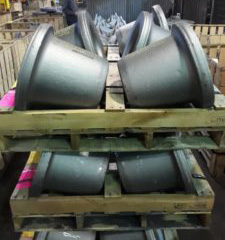
An aircraft torque tube is a critical structural component of an aircraft’s wheel braking system. Mounted within the wheel assembly, the brake torque tube serves as the stationary anchor that houses the brake disc stack and absorbs the torsional and thermal loads generated during each landing stop. When the braking system is engaged, hydraulic pistons press the rotating brake discs against the stationary torque tube, transferring kinetic energy into heat and bringing the aircraft to a controlled stop.
Because the aircraft brake torque tube must absorb extreme torsional stress, compressive loading, and elevated temperatures on every landing cycle, it demands both exceptional material strength and precise dimensional control. That is why closed-die drop forging — rather than machining from billet or casting — is the standard production method for aircraft brake torque tubes in commercial and military aviation.
Aircraft Torque Tube Forging Capabilities
Canton Drop Forge produces aircraft torque tubes from 17-22AS steel — a high-strength, heat-treatable alloy widely specified for aircraft braking system components due to its excellent toughness, fatigue resistance, and dimensional stability under thermal cycling. Our torque tube forgings are supplied in heat-treated and fully machined condition, ready for integration into your braking system assembly.
Our aircraft brake torque tube capabilities include:
- Closed-die drop forging for precise, repeatable torque tube geometry
- 17-22AS steel and other aircraft-quality re-melted steels for braking system applications
- Complete heat treatment in our Nadcap-approved furnaces to develop final mechanical properties
- Full machining to customer specifications, eliminating the need for downstream finishing operations
- In-house die sinking for controlled dimensional tolerances across production runs
- Engineering and design support from initial drawing review through finished part
Our forging facility covers more than 240,000 square feet and is equipped with 13 forging hammers — including some of the largest drop forge hammers in the world — giving Canton Drop Forge the capacity and consistency to produce aircraft torque tube forgings at the scale required by major aerospace programs.
The Aircraft Torque Tube Forging Process
Each aircraft brake torque tube produced at Canton Drop Forge follows a tightly controlled workflow from billet to finished part:
- Material Selection & Billet Preparation — Aircraft-quality 17-22AS steel billet stock is sourced with full melt traceability, verified against material certifications, and saw-cut to precise weight prior to forging.
- Controlled Heating — Billets are heated to closely controlled temperatures within the steel’s optimal forging range to ensure consistent grain refinement and prevent decarburization.
- Closed-Die Drop Forging — The heated billet is struck in precision-machined closed dies, forming the torque tube to near-net geometry while consolidating grain structure for maximum torsional and fatigue strength.
- Trimming & Cleaning — Flash is trimmed and the forging is cleaned in preparation for heat treatment.
- Heat Treatment — Torque tube forgings are heat treated in our Nadcap-approved furnaces to achieve the specified tensile strength, hardness, and toughness required for aircraft braking system service.
- Machining — Forgings are machined to final dimensions and tolerances as specified in customer drawings, delivered ready for assembly.
- Inspection & NDT — Each torque tube forging undergoes dimensional verification and non-destructive testing to confirm conformance to print and applicable aerospace quality standards.
Why Forging Is the Standard for Aircraft Brake Torque Tubes
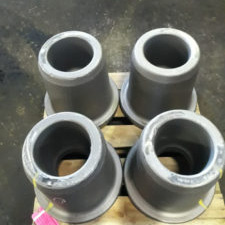
Aircraft brake torque tubes are subject to some of the most demanding load conditions of any structural component on the airframe — absorbing repeated torsional shock, thermal cycling, and compressive loading on every landing. Closed-die drop forging is uniquely suited to producing torque tubes that reliably withstand these demands across a full service life. For a full breakdown of how forging compares to casting across aerospace applications, see our forging vs. casting analysis.
Key advantages of forged aircraft torque tubes over machined or cast alternatives include:
- Optimized Grain Flow — Forging orients the grain structure of 17-22AS steel to follow the geometry of the torque tube, maximizing resistance to torsional fatigue and crack propagation at the highest-stress locations.
- Superior Toughness — Forged torque tubes exhibit greater impact toughness than cast or machined-from-billet alternatives, reducing the risk of fracture under the dynamic shock loads generated during heavy braking.
- Consistent Mechanical Properties — The closed-die process produces uniform microstructure and properties across every forging in a production run, ensuring lot-to-lot reliability for large commercial and military aircraft programs.
- Near-Net-Shape Efficiency — Forging reduces the amount of material removal required in machining, improving buy-to-fly ratio and overall production efficiency.
- Full Material Traceability — Every torque tube forging leaves our facility with complete documentation supporting AS9100 and Nadcap compliance requirements.
For a broader view of how we approach aerospace forging quality, visit our aerospace forging page.
Contact CDF for Custom Aircraft Torque Tube Forgings
Quality, consistency, and decades of program experience have established Canton Drop Forge as the premier U.S. supplier of forged aircraft torque tubes. Our torque tube forgings are used in braking systems on virtually every major domestic and international commercial aircraft, as well as military platforms — a testament to the reliability of our process and the trust aerospace OEMs place in our team. Whether you are sourcing for a new commercial program, a military platform, or a replacement supply chain, our engineering team is ready to work from your drawings and specifications to deliver aircraft brake torque tube forgings built to your exact requirements. Contact us today to get started.
Frequently Asked Questions About Aircraft Torque Tube Forging
What is an aircraft torque tube?
An aircraft torque tube is a structural component in an aircraft’s wheel braking assembly. It acts as the stationary mounting point for the brake disc stack and absorbs the torsional force and heat generated when the brakes are applied during landing. Because it must withstand severe and repeated loading on every landing cycle, aircraft torque tubes are produced by closed-die drop forging for maximum strength and fatigue resistance.
What material is used for aircraft torque tube forgings?
Canton Drop Forge produces aircraft brake torque tubes from 17-22AS steel — a high-strength, heat-treatable alloy specifically suited for aircraft braking system applications. The material is sourced from aircraft-quality, vacuum re-melted stock with full melt traceability to meet aerospace certification requirements.
Does Canton Drop Forge supply machined torque tube forgings?
Yes. Canton Drop Forge supplies aircraft torque tube forgings in both rough-forged and fully machined condition, heat-treated to customer specifications. Fully machined parts are delivered ready for integration into braking system assemblies without requiring additional downstream operations.
What aircraft programs use Canton Drop Forge torque tubes?
Canton Drop Forge torque tube forgings are used in braking systems on virtually every major domestic and international commercial aircraft, as well as a wide range of military platforms. Our long-standing relationships with aerospace OEMs and Tier 1 manufacturers reflect our consistent ability to meet the volume, quality, and traceability requirements of large aircraft programs.
How are aircraft torque tube forgings inspected? torque tubes?
All aircraft torque tube forgings produced at Canton Drop Forge undergo dimensional verification and non-destructive testing to confirm conformance to print. Inspection is performed by our Nadcap-certified technicians as part of our standard production workflow, with full documentation provided to support aerospace quality audit requirements.
What is the difference between an aircraft torque tube and a brake disc?
A brake disc is a rotating component that spins with the wheel and generates friction during braking. The aircraft torque tube is stationary — it provides the structural anchor to which the brake discs and actuating pistons are mounted, and it absorbs the torsional load transferred from the rotating disc stack. Both components are critical to the braking system but perform distinct structural roles.